Museum displays convey to the visitor intellectually and socially distilled knowledge,
emotions and experience. They are furthermore crafted to present a set of narratives that
organize information into digestible portions. These story-threads are often linear,
are meant to be experienced in predetermined orders and are politically driven.
These politics may be financial (e.g., stories influencing purchases) or social
(e.g., organizing information to raise awareness of an issue) or otherwise.
At the same time museums attempt to prescribe a narrative via a physical display,
interactive technologies are emerging that allow more fluid, and perhaps subversive,
wayfinding methods for visitors. As Andrew Barry argues in his article On Interactivity,
"Interactivity promises ... to turn the museum visitor into a more active self."
With the aid of new technologies, then, the visitor may alter the museum from an
experienced narration to a stochastic experimentation.
However, Barry also posits that some so-called interactive technologies may not
be anything more than novelty items. "Many ... interactive ... computers ... ," he writes,
"merely serve to create the illusion of choice." Indeed, it may be that far from allowing
visitors to subvert or circumnavigate primary narratives, interactive technologies merely
augment a priori configurations.
Do interactive technologies fundamentally alter a visitor’s experience?
To attempt to answer this question I spent one afternoon at the
San Francisco Museum of Modern Art observing the use of two systems:
the digital audio tour provided for a fee at the Ansel Adams special exhibit,
and the handheld PCs available at the Points of Departure gallery.
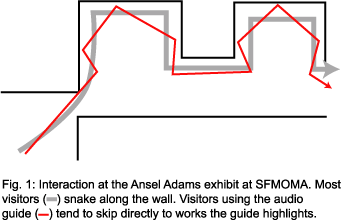
From my observations I gleaned that visitors using interactive technologies
peruse exhibits in a depth-first manner (Fig. 1). That is, while other visitors
usually looked briefly at each and every work, those with interactive devices
tended to visually search for, and spent most of their time in front of, pieces
discussed on those devices, while passing over other works. In this way, the
interactive device acts as a secondary filter by indirectly indicating that
some of the works on display are somehow more important than others.
Interactive devices should not limit exploration but encourage it. In response
to this issue I devised a prototype system that would 1) take the pieces out of the
context of their physical arrangement in the gallery, 2) provide information on
every artwork and 3) would show typical paths followed by other visitors. This arrangement
would allow visitors to both get a sense of the most commonly followed paths through the
museum as well as quickly find the most popular pieces. While most visitors would use
this collaborative filtering to guide their path, other, more adventuresome visitors
can make the choice to follow the "the road less traveled by."
This prototype supports patterns developed in this class. For the sake of simplicity,
I chose to display only six patterns (chosen randomly). When using the system, imagine
that it is something you can hold in your hand as you peruse the "gallery of patterns."
Roll your mouse over a piece to see a brief summary, or click on it to provide more
in-depth information. Your path through the museum is automatically recorded. Other
people's paths appear automatically (simulated).