Wodiczko's design for a habitable cart is useful only for those homeless who are scavengers. Based on what I have read in homeless street papers, heard from the homeless themselves and read in National Coalition for the Homeless reports, I believe that while many homeless may be gatherers and collectors, many could also be more aptly described as transients. Many homeless wonder through towns and cities trying to "find a place" in which they fit. In many cases the places they eventually stay for the long term are places where they develop more connections, find jobs and find help. Frequently, these connections develop serrendipidously (e.g. when a stranger takes them in for a night and later offers a job, et cetera).
A number of questions arise when one considers how a new technology might be
able to help transients:
How can technology help these transient homeless feel connected to a space?
What kind of technology would they be comfortable with?
Where will it be located?
Who will have control?
Necessary characteristics
Devices for the transient homeless must be portable, cheap and durable. Furthermore, if users are to carry the device around with them at all times, there needs to be a means of identification. Finally, users should be able to get essentially information easily, but there should be ways for the users to input information to the system that perhaps require more dexterity and knowledge.
My solution
To aid the transient homeless become more aware of their community, I propose a portable handheld client that can wirelessly sync with mechanical hotspots located in city parks or on busy streets. The client devices themselves would sit in an unlocked bin (we want to encourage people to "steal" them) underneath the hotspot. Each client should have a name and should be registered with a backend service. When handled, the client would wake up and display relevant information, including the nearest soup kitchen, nearest shelter, other locations or people they can call on to get help, jobs and possible education opportunities. The initial screen should be simple and supply push-content only (fig. 1). However, more advanced users may be able to use the device to communicate with other transients using their device-specific handle, recommend new places or services and rate current ones. Possible extensions include rudimentary classes in reading and math or online couceling guides. Finally, users should be able to sync the device with hotspots in other towns (fig. 2).
Control
The National Coalition for the Homeless could run the system, getting information from regional sites and distributing the information to hotspots. Users would hopefully begin to take over content generation, though, via Babble-like chat and BBS systems and recommendations. Also, the clients should use two or three year old technology to reduce cost and lower the chance of pawning.
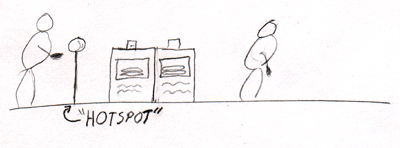 Figure 2. A user updating their device at a hotspot

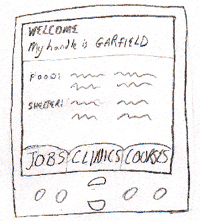
Figure 1. Possible first page