I once again visited the Starbucks on Solano Ave., this time to observe the convergence of public and private spaces, especially that convergence involved technology. I found three patterns of interaction: laptop users live in a world of their own, if you can't see them, you can't here them and conspicuous (private) business affairs.
laptop users live in a world of their own
The three laptop users in the cafe rarely interacted with anyone, or anything
other than their laptop. They ignored other conversations and talked to no one.
Why go to a cafe and maintain such a strict private bubble? Perhaps because they were able to
compare themselves to others who were not concentrating they were able to concentrate
more themselves?
if you can't see them, you can't hear them
People attempt to block out other conversations when they want to focus
on personal matters (e.g., reading a paper) by blocking out their own vision.
I first noticed this when a man (on Figure 1, the middle-left red dot)
began a conversation on his cell phone. Customers adding sugar
and creme to their coffees at a nearby condiment table would typically
shoot their head up for a quick glance at the man, who was turned in their
direction, and then quickly turn their back on him or move one hand
to their forehead so that it blocked their view in that direction. Later,
when a woman with a bizarre accent began a bizarre conversation regarding
artwork sales (see next section), another woman at a nearby table began shielding
her gaze from the offending table. As the artwork conversation increased in
volume and oddity, the woman withdrew and turned to face the opposite direction.
conspicuous (private) business affairs
People sometimes indirectly boast about their private affairs in public spaces.
One female staff member came in bearing a box of Krispy Kremes and shouted out that
they were only for people who had done their chores on time (on Figure 1, the
middle-right red dot). Well, I did
my household chores on time this week, so do I get a donut? No, she was directing
her conversation toward the Starbucks staff members. But she pranced and paraded
the donuts and clearly wanted to be noticed publicly. Soon thereafter a small
elderly lady with a high, squeaky, undulating voice sat herself down in the
table directly to my right. An older gentleman soon joined her (they are the
red dots on the lower right of Figure 1). Her voice
was quite strange and, frankly, annoying. Some people reacted to this (see
previous section) but most ignored her. Eventually, though, she became adamant
and raised her voice. It was impossible not to eavesdrop. She was apparently
an art dealer who had loaned this man money five years ago and was now looking
for a payment. "Today!" she kept exclaiming, "How are you going to get the
money to me today? Will you get a loan? Sell something? What?" The man
retorted that he had a sale coming up and would give her a cut. But she got
more and more excited, tossing in a mix of exclamations
and obscenities into her relentless, squeaky tirade. Everyone in the back
of the cafe could not help but hear the conversation. Perhaps she was using
implied public awareness to pressure him. Whatever she was doing, it worked -- when
I left they were discussing a payment plan.
Distributed conversation awareness
The Topological Research Lab at Georgia Tech has, with the help of a handful of artists living in San Francisco, built a system designed for a public space that visualizes words uttered by bystanders or nearby pedestrians on a large display (Figure 2). What if we applied this same idea to distributed cafe spaces? I envision a network of a few cafes scattered across the country in which microphones record conversations at each table and public space while a backend system grabs from these recordings in real-time out-of-context individual words and small phrases. The backend service could then send these utterances to all of the other cafes on the network, where they could be displayed on large monitors (Figure 3). In this way, your humble cafe conversation could easily percolate across the country . The problem is of course that people will not want to be recorded for privacy concerns. To encourage use of the system the cafe network should provide a low cost incentive. A prize could be given out randomly to those using the microphones, for example.

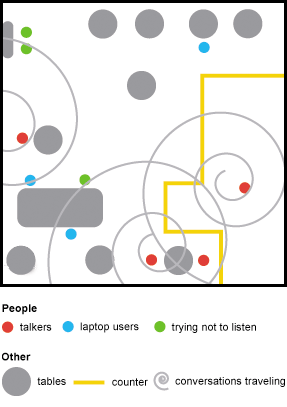
Figure 1. Private/public communication in a cafe


Figure 2. The Hubbub project
Figure 3. Inside your local cafe...