With the rise of Internet and interactive art, there is an increasing need for non-traditional, Internet-only display spaces.
There are a large number of Internet manifestations of real-world museums. There are far fewer museums that can be visited on the Internet only, and do not have a physical manifestation.
Internet art forms rarely have a place in modern museums. Those that are put on display are either on public machines in a gallery, in which case the physical presence of the computers themselves unintentionally become a part of the artwork, or on machines in media rooms, where the art is relegated to a utility space. In fact, Internet art may have no place in physical museums, and require instead a virtual space where visitors can separate the aspects of their haptic environment from the artwork.
The Internet has not only inspired new forms of art, but also creative ways of navigation and information dissemination that may augment the experience of physical works. A physical art museum limits the visitor's ability to explore tangential experiences -- in a virtual space, one might look at a representation of The Victory of Simothrace, note that it adorned a ship, think of Viking ships and, with little effort, immediately navigate to a site detailing the ships in the Roskilde Viking Museum. If mediated through a coherent shell, the ease of transition in Internet spaces could lead to serendipitous, creative juxtapositions.
It is undesirable, then, for an Internet museum to take on exactly the characteristics of a physical museum. Several online museums, including a system in development at the Nordic Institute for Contemporary Art, attempt to recreate the sense of being in a physical space. Usually, this direct mapping between physical and virtual spaces results in the limitation of possibilities. Why throw up walls when walls are unnecessary?
T h e r e f o r e . . .
Design online-only museums for the display of Internet art or as a way of exploring
physical works that may never be housed in the same museum. Use the medium as a guide for developing
spacial layouts and try not to map physical spaces to their virtual equivalents.
And most importantly, do not be hesitant to give up control to the users.

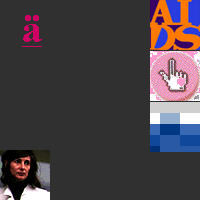 äda web houses a variety of Internet art works and uses the malleability of Internet content
to give users a different view of the site each time they enter.
äda web houses a variety of Internet art works and uses the malleability of Internet content
to give users a different view of the site each time they enter.
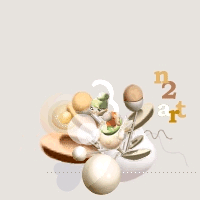 n2art, Nordic netart, presents works in a style more associated with traditional Internet layout.
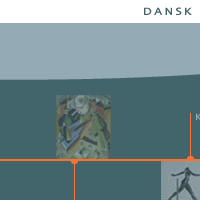 The Virtual Museum provides images and information about modern, physical Danish pieces
of artwork. The pieces in this museum, therefore, are chosen thematically rather
than because of their mutual presence in one physical space.
The Virtual Museum provides images and information about modern, physical Danish pieces
of artwork. The pieces in this museum, therefore, are chosen thematically rather
than because of their mutual presence in one physical space.
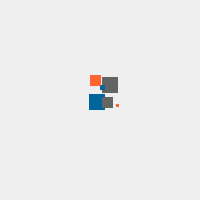
!hobgoblin is my attempt to deal with the notion of an online museum. The !hobgoblin interface
acts as a wrapper around various other artworks scattered across the Internet. In a pop-up window,
users are presented
with a few images, each representing a different work (broadly construed).
When the user clicks on an image, the main window browses to that artwork while the !hobgoblin
interface morphs to reflect the path the user has taken to that point. Users may also freely
add new works to the museum.